
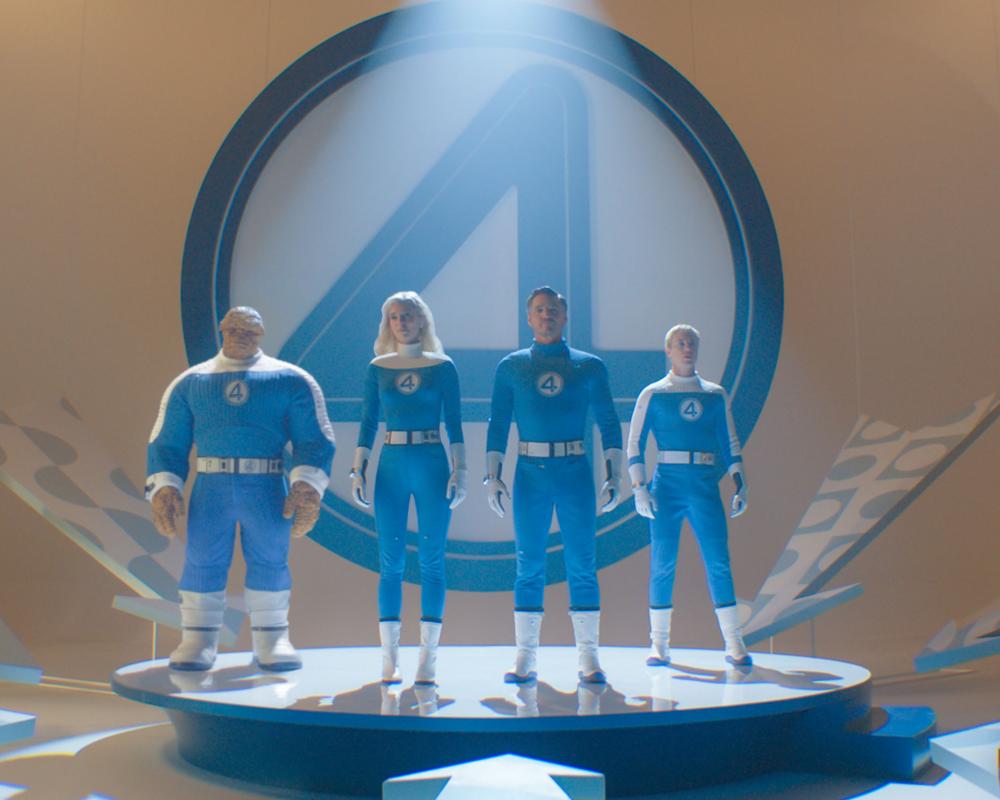
A Fresh Take on Marvel's First Family: 'The Fantastic Four: First Steps'
'The Fantastic Four: First Steps' boldly deviates from the typical Marvel formula, presenting a unique blend of futuristic fantasy, familial drama, and cosmic horror. Instead of adhering to the usual interconnected cinematic universe structure, this film offers a more intimate and self-contained narrative. Picture a retro science fiction bedtime story that culminates in a new mother launching a menacing space deity into a cosmic refuse sack.
This iteration of the Fantastic Four finally grasps the essence of the team's appeal. Their strength isn't rooted in sheer power or intellect, but in their relatable imperfections, their humanity, and their capacity to function amidst utter chaos. While the fate of their retro-futuristic version of Earth (Earth-828) hangs in the balance and a character gives birth to a child with potentially godlike abilities, the film's most memorable aspects are the characters' interactions, their affection for one another, and their genuine on-screen chemistry.
While not without its flaws – the film's pacing meanders at times – large portions of it feel like the best origin story Marvel has produced in years. It's a superhero film brimming with heart, intelligence, and delightfully bizarre cosmic elements.
A Marvel Movie That Stands Alone
One of the most appealing aspects of 'First Steps' is how refreshing it feels to watch a Marvel film with a clear beginning, middle, and end. There are no portals leading to future phases, no cameo appearances designed to remind viewers of the interconnected universe, and no sense that the entire film is merely a setup for a Disney+ spin-off. Instead, the focus remains on four individuals, a child with extraordinary powers, and a captivating retro-futuristic setting.
The decision to set the film in an alternate universe, where advanced space travel and flying cars are commonplace by the 1960s, proves to be a masterstroke. It injects a vibrant, Apollo-era aesthetic and a sense of chrome-plated optimism into a narrative that could easily have become another murky addition to the multiverse saga.
Crucially, director Matt Shakman delivers a Fantastic Four team that truly embodies the title of Marvel's First Family. Reed Richards is portrayed as a brilliant but detached scientist who approaches parenthood with the same analytical rigour he applies to physics. Johnny Storm, a hot-headed, flame-powered individual, surprisingly manages to deliver some of the film's most emotionally resonant moments. Sue Storm serves as the team's anchor, providing stability and emotional intelligence. Ben Grimm, a sorrowful figure trapped in a rocky form, delivers poignant lines with a gravelly voice and a stoic Brooklyn attitude. While these elements may seem simple, they represent a significant improvement over previous attempts to portray this iconic superhero team.
Sue Storm's Long-Overdue Character Arc
Previous film adaptations of the Fantastic Four often reduced Sue Storm to a reactive character, primarily responding to the actions of male characters or engaging in sibling squabbles. In contrast, Vanessa Kirby's portrayal establishes Sue as a powerful force to be reckoned with. She's depicted as a superhero capable of standing against cosmic threats, moderating Reed's more extreme scientific tendencies, and serving as the team's emotional centre. She's not relegated to the sidelines while the men save the world; instead, she's proactive, pragmatic, and essential to the team's survival. It's Sue's force field that ultimately turns the tide against the oncoming cosmic storm, not Reed's equations or Ben's brute strength. For once, the Invisible Woman makes a lasting impact.
Terrifying Childcare and Great Power
One of the most unusual and surprisingly touching aspects of 'First Steps' is its portrayal of Sue's pregnancy and the impending birth of Franklin Richards. The film explores the anxieties and responsibilities that come with parenthood. Like any new parents, Mister Fantastic and the Invisible Woman are confronted with the daunting prospect of raising a child they can barely understand. But, as comic fans know, their child isn't just any baby; he's a potentially universe-altering being with immense power.
The film avoids sentimental clichés. There are no cheesy monologues about motherhood or slow-motion shots of cradles. Instead, it captures the panic, wonder, and overwhelming love that accompany the arrival of something entirely new.
Cosmic Horror Done Right: Galactus and the Silver Surfer
The film elevates the supervillain game with the introduction of Julia Garner's Shalla-Bal, a captivating herald of destruction. Then there's Galactus, a being of immense power, more akin to a celestial event than a conventional villain. How does one combat something so vast, so ancient, and so indifferent to human concerns? While Thanos pursued mass murder with a cold, calculated efficiency, Galactus operates without motive. He isn't evil; he's entropy embodied, a planetary force with its own cosmic agenda.
'First Steps' comes closest to capturing genuine cosmic horror. Galactus isn't just a powerful threat; he's something unknowable, inscrutable, and fundamentally indifferent – akin to being judged by a black hole. The only way to defeat him, at least temporarily, is to banish him to another dimension, making him someone else's problem.
Doctor Doom and the Future of the Avengers
The film hints at Franklin's immense power, suggesting he may be even more powerful on screen than he is in the comics. If he can resurrect his mother, could he also create new worlds and break down the barriers between universes using his mind? This could explain Doctor Doom's interest in Franklin in the mid-credits scene, which takes place four years after the film's events. Doom's silent observation of the child suggests a malevolent intent.
The identity of the actor portraying Doctor Doom remains a mystery. Is this a Tony Stark variant, or is the resemblance purely coincidental? Does this scene directly set up the next film, or is it simply a distraction? Showing Doom kidnapping Franklin and triggering a multiversal rescue mission might seem too obvious for Marvel. However, it could explain the presence of a retro-finned rocket, painted in Baxter Foundation colours, heading towards the solar system. Is this a clever misdirection, or a clear indication of what's to come?
Post a Comment