
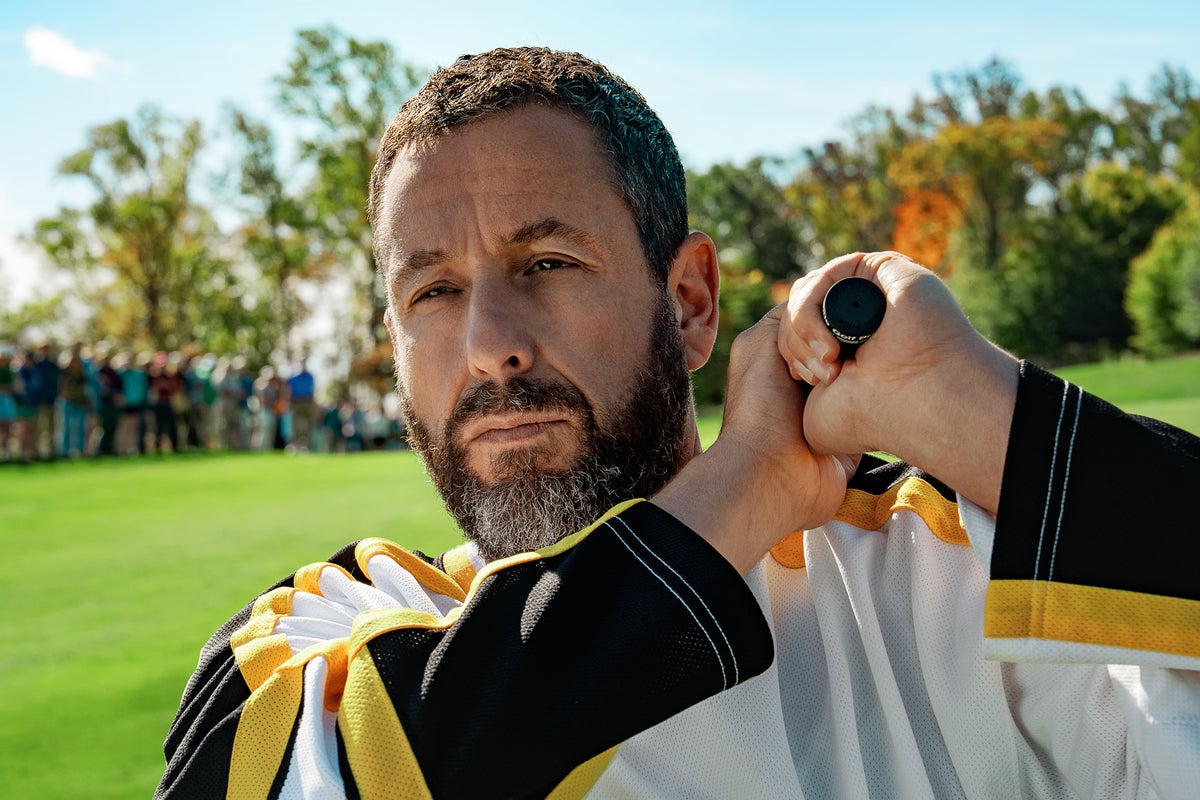
The curious case of Adam Sandler often leads to a discussion of two distinct personas. There's Sandler One, the king of mainstream comedy, responsible for films like Happy Gilmore, Click, and Grown Ups – a figure who has cultivated a vast empire on the back of accessible, often silly, humour. Then there's the elusive Sandler Two, a performer capable of considerable skill, depth, and credibility, who surfaces occasionally in critically acclaimed, director-driven projects such as Uncut Gems, Punch-Drunk Love, and The Meyerowitz Stories. These two Sandlers seem locked in a perpetual battle, never quite merging. This dichotomy has become a common way to understand the phenomenon that is Adam Sandler.
Happy Gilmore 2, which recently premiered on Netflix, initially appears to fall squarely into the Sandler One category – the kind of film that might be dismissed as pure silliness. It's a sequel to the 1996 comedy Happy Gilmore, where Sandler plays a golf prodigy with anger management issues. This sequel is part of a long-standing, multi-film agreement with Netflix, a partnership that has largely kept Sandler away from cinemas for the past decade and reportedly earned him hundreds of millions of pounds. Like many of his productions, Happy Gilmore 2 is a broad, lighthearted comedy, packed with celebrity cameos and slapstick routines. Reviews have been mixed, typical of Sandler's Netflix output, described by some as "strictly for the fans". The film features scenes where a character seemingly inspired by a well-known rapper is attacked by alligators, purely for comedic effect.
However, with the notable exception of Jack and Jill (2012), the idea of two entirely separate Adam Sandlers is a simplification. While it's tempting to categorise Sandler's work into neat boxes of "high" and "low" art, "good" and "bad", this doesn't accurately reflect the nuances of his career. In its own way, Happy Gilmore 2 is a surprisingly insightful reflection of Sandler as an artist, encapsulating his strengths, his limitations, and even a surprising amount of heart.
Sandler's comedies are often labelled as pure juvenile entertainment, and there's certainly evidence of that in his films. Some jokes land, others miss the mark. But almost all of his films contain a strong undercurrent of sentimentality, a willingness to embrace genuine emotion amidst the chaos.
Happy Gilmore 2 begins with a significant event: Happy's wife, Virginia, who was played in the original Gilmore by Julie Bowen, meets an unfortunate end after being struck by a stray golf ball. This leaves Sandler's character a grieving widower. While the death is handled with a degree of levity, it also introduces a sombre note that subtly influences Sandler's performance. This version of Happy Gilmore is far removed from the hot-headed man-child of the original. The more mature, family-oriented character aligns him with some of Sandler's more nuanced roles, such as the struggling basketball scout he portrayed in 2022's Hustle.
The original Happy Gilmore heavily featured Sandler's most talked-about on-screen trait: his anger. He portrays an explosive temper, exaggerated to comical extremes. (He even starred in a film explicitly titled Anger Management.) However, in most of his work, this anger is balanced by a softer side, an inherent likeability that softens the harsher aspects of his persona. This applies equally to a film like Uncut Gems – in which Sandler is alternately pathetic, infuriating, and chaotic as the gambling addict Howard Ratner – as it does to Happy Gilmore.
Another constant throughout Sandler's career is his reliance on a close-knit group of collaborators, and this is particularly evident in Happy Gilmore 2. Significant roles are given to members of his immediate family – his daughters, Sunny and Sadie Sandler, both have prominent parts, while his wife Jackie also appears – but also to his broader social circle. This network includes formidable talents, such as Steve Buscemi, and actor-director Benny Safdie (who plays the film's obnoxious villain), as well as long-time associates like Rob Schneider (who is thankfully limited to a brief cameo).
Sandler has faced criticism for what some perceive as blatant nepotism. However, it's also become an integral part of his brand – this image of the actor as a loyal and generous friend to all. It's a persona that has endured over decades, surviving Sandler's rise from movie stardom to a level of wealth that might have alienated him from his audience. Every role Sandler plays draws, in some way, on this innate likeability.
Later this year, Sandler will star in Jay Kelly, the latest film from Noah Baumbach, the Oscar-nominated director who elicited a sublime and subtle performance from him in 2019's The Meyerowitz Stories. Given Baumbach's previous work, it's likely to be a sophisticated, well-acted film; expect it to be placed firmly in the "good Sandler" category.
Happy Gilmore 2 will inevitably be relegated to the other pile. But there's value in what he's doing here – heart, sincerity, and comedic inventiveness. It may be "for the fans", but Adam Sandler has a lot of fans for a reason.
Post a Comment