
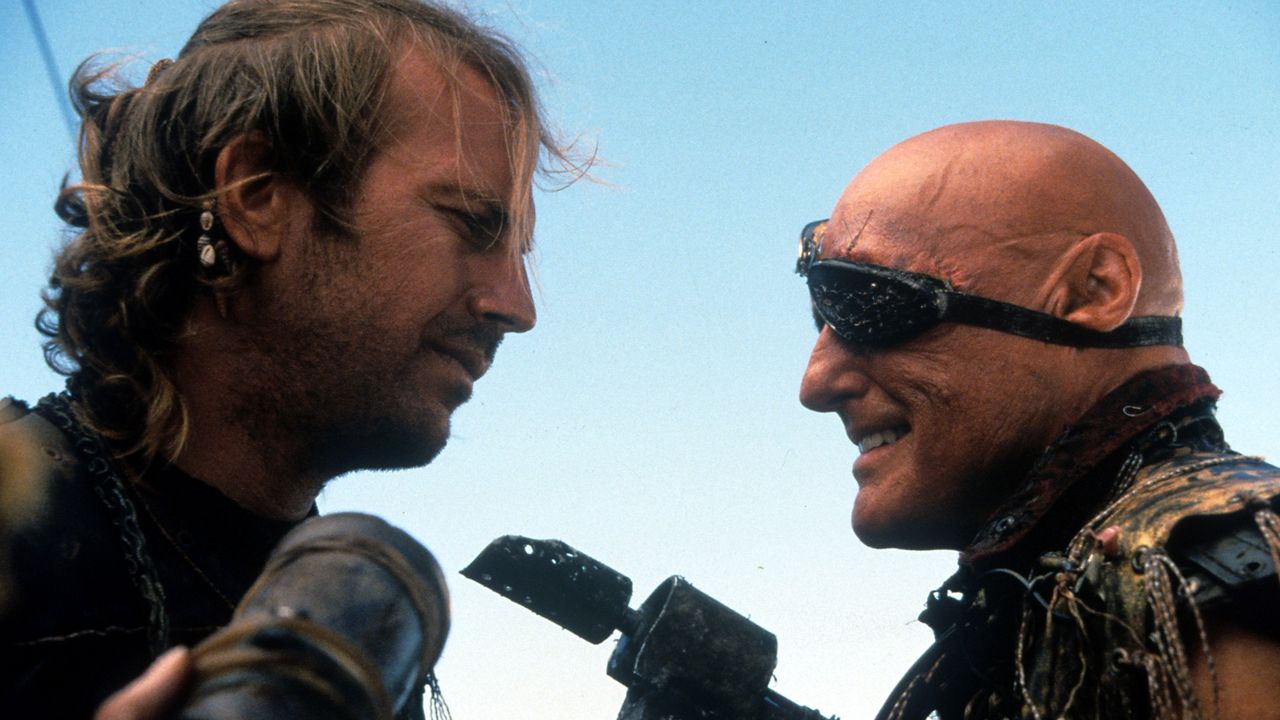
Waterworld: A Retrospective on a Production Plagued by Problems
Before its release in July 1995, "Waterworld" faced a barrage of negative press. Despite starring Kevin Costner, fresh from successes like "Robin Hood: Prince of Thieves," "The Bodyguard," and "Field of Dreams," the film's ballooning budget made it a target for a media frenzy.
The production was fraught with challenges unique to filming at sea, and creative disagreements led to the early departure of director Kevin Reynolds, who had previously clashed with Costner during "Robin Hood."
By the time "Waterworld" was released, it had already earned unflattering nicknames like "Fishtar" and "Kevin's Gate," alluding to notorious box office failures. However, the film proved to be far from the disaster many predicted. While it barely scraped into the US box office top 10 for the year, trailing behind hits like "Batman Forever" and "Apollo 13," it likely would have been considered a success if its production hadn't cost an unprecedented $175 million. Stronger international performance, where negative publicity had less impact, and respectable VHS sales ensured that "Waterworld" eventually turned a profit.
Now, approaching its 30th anniversary, it's easier to look past the financial woes and the film's undeserved reputation as a flop. Despite its flaws, "Waterworld" remains an ambitious and visually spectacular piece of filmmaking from a time when practical effects reigned supreme.
It deserves more credit than being dismissed as simply "Mad Max: The Sea Warrior," even though original screenwriter Peter Rader has acknowledged that he initially aimed for a similar dystopian feel.
A Glimpse into the Submerged Future
"Waterworld" presents a future where the Earth's polar ice caps have melted, submerging the entire planet. The film never explicitly states the year, but the premise is immediately established by the flooding of Universal Pictures' iconic globe logo. Beyond the global warming parable, the film focuses on a high-octane race to find the mythical "dry land."
The film's substantial budget is evident in its visuals, benefiting the Hawaiian economy where much of it was filmed.
Production Nightmares at Sea
Before filming commenced, Reynolds sought advice from Steven Spielberg, a veteran of challenging on-water shoots ("Jaws"). Spielberg advised against filming on the ocean, suggesting studio sets or giant water tanks instead. Universal CEO Sid Sheinberg also cautioned the production team to expect costs to exceed their budget by at least 25%. This proved to be an understatement.
Reynolds likely regretted not heeding Spielberg's warning when Costner was stranded atop a mast during a storm, and a major set, a slave trader outpost, was destroyed by a hurricane. Additional expenses included chartering extra boats to transport support staff, such as make-up artists and stunt performers, to the offshore locations.
The decision to film the final battle, set on an oil tanker, on dry land, using green screens and digital effects, must have been a relief. The underwater sequence where the Mariner shows Helen a submerged city was created with detailed models, including a recreation of the Orca, Quint's boat from "Jaws."
Despite the challenges, Reynolds' commitment to filming on real waves brought a remarkable level of authenticity to "Waterworld," solidifying its status as a triumph of world-building.
The Mariner and the World He Inhabits
The film introduces the Mariner, who is seen filtering and drinking his own urine, showcasing his complete adaptation to his environment. His highly modified trimaran is a standout element, a meticulously engineered vessel perfectly suited to its owner.
The Mariner stands in stark contrast to the "Smokers," the film's antagonists who inhabit a rusted-up version of the Exxon Valdez tanker, which ran aground in Alaska in 1989. Led by Dennis Hopper's Deacon, they represent a society unable to break its dependence on fossil fuels. While "Waterworld" doesn't explicitly explain the Earth's submersion, its eco-friendly message is clear.
The residents of the Atoll, a floating settlement, represent humanity's last stand, adapted to survive in an environment they are ill-suited for. Dirt is a valuable commodity, and everything is recycled, even the deceased. However, like "Mad Max," this is a lawless society where trust is a dangerous commodity.
Script Shortcomings and Character Flaws
The script, however, struggles to match the film's impressive setting. Despite Hopper's enthusiastic performance and last-minute script revisions by Joss Whedon, genuine humour is scarce. Efforts to shorten the runtime resulted in excessive cuts, although much of the excised footage, including a scene confirming that dry land is Mount Everest, can be found in the extended TV and "Ulysses" cuts available on Blu-ray.
The Mariner, overshadowed by his boat, is a sullen and uncharismatic protagonist who lacks conviction when he transforms into a superhuman hero in the final act. While this character arc was typical of 90s action films, the decision to make him an Ichtyus Sapien, with gills and webbed feet, feels like a contrived plot device.
The premise of a completely submerged planet stretches credibility, even with dramatic license. While the US Geological Survey estimates that melting glaciers and ice caps would raise sea levels by approximately 70 meters, the film compresses millions of years of evolution into a few centuries. Even the largest budget in Hollywood history at the time can't always ensure believability.
"Waterworld" is available for rental and purchase on various streaming platforms.
Post a Comment